
Aranya Kanda: The Forest Years
Panchavati, Shurpanakha and the Fall of Khara
Jatayu befriends the exiles at Panchavati. Ravana's sister Shurpanakha attacks Sita and is punished, and Ram alone destroys Khara's army of fourteen thousand.
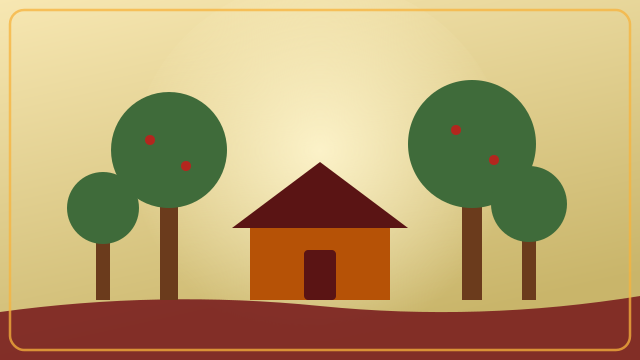
On the way to Panchavati a very large vulture sat on a great banyan tree. Ram took him for a rakshasa. The vulture spoke gently: "Child, I am Jatayu, a friend of your father Dasharatha. If you wish, I will live here near you. When you and Lakshmana go out, I will guard Sita." Ram bowed to him and embraced him.
Panchavati really was beautiful: the clear water of the Godavari, a pond full of lotuses, trees heavy with fruit. Lakshmana raised walls of earth, set up bamboo posts and laid a roof of grass and leaves. When Ram saw the hut he held Lakshmana to his chest. "You knew what was in my mind. Today I feel that our father has not gone; he is with me in you."
Here the three spent very happy days. Early winter came. One morning, after bathing in the Godavari, they sat in the hut talking.
Shurpanakha
A rakshasi came there. She was Shurpanakha, sister of Ravana, king of Lanka. Seeing Ram, she was infatuated. "I am Ravana's sister," she said. "Leave this thin human woman and marry me."
Ram was amused. "Lady, I am already married. Go to my younger brother." Lakshmana laughed too. "I am only his servant. What would you gain as a servant's wife?" Shurpanakha decided that Sita was the thorn in her path. She took her true and terrible form and rushed at Sita to devour her.
Ram shielded Sita and said, "Lakshmana, one should not jest with the cruel. Punish her." Lakshmana cut off her nose and ears with his sword. She fled screaming into the forest.
Khara and Dushana
In nearby Janasthana lived her brother Khara with an army of fourteen thousand rakshasas. Shurpanakha fell before him covered in blood. Khara first sent fourteen rakshasas, and Ram felled them with fourteen arrows. Then Khara marched with his whole army and his generals Dushana and Trishira.
Ram saw ill omens in the sky and said to Lakshmana, "Take Sita to that cave and stay there. I will deal with them alone. This is my oath; do not argue."
What followed drew gods and sages to gather in the sky and watch. On one side fourteen thousand; on the other, one. The rakshasas rained spears, maces and rocks. Blood ran from Ram's body, but arrows left his bow so fast that no one could see him draw or release. Dushana fell. Trishira fell. Khara shattered Ram's armour. Then Ram took up the bow Agastya had given him, and Khara's end came. All of it took about an hour and a half.
The sages said, "Ram, it was for this that we brought you here." Sita came running from the cave and embraced her husband.
The news reaches Lanka
One rakshasa of that army, Akampana, escaped. And Shurpanakha herself reached Lanka. In the full court she rebuked her brother: "You are sunk in pleasure and your spies are asleep. One man, alone, has laid Janasthana waste." Then she said the thing that sank into Ravana's mind: "His wife, Sita, is such a woman as I have not seen in the three worlds. She is fit for you. Carry her off, and Ram will die of himself."
Ravana rose without a word and walked to his chariot.
Last updated:
Read next

Hanuman: Life, Stories and Devotion to Ram
Hanuman, son of Anjana and Kesari: his birth, the leap to Lanka, the Sanjeevani mountain, why he is worshipped first in Ayodhya, and what he teaches.

Sita: Daughter of the Earth
Sita, found in a furrow by King Janaka, wife of Shri Ram: her birth, marriage, exile, captivity in Lanka, her sons, and why she is revered as Lakshmi.
Bharata: The King Who Refused the Throne
Bharata, son of Kaikeyi, was given Ayodhya and gave it back. He ruled for fourteen years from Nandigram in the name of Shri Ram's sandals.
Equality and Compassion: Shabari, Kevat and Jatayu
Shri Ram ate a tribal woman's berries, embraced a boatman and gave a bird a father's funeral. What these episodes teach about dignity and birth.
Victory over Ego: The Lesson of Ravana
Ravana had learning, power and a golden city, and lost them all to pride and desire. Why the Ramayana makes its villain a scholar, and what that warns us of.

Ram Rajya: Leadership as Service
What Ram Rajya meant in the Ramayana, the principles behind it, and how they apply to anyone who leads a family, a team, a business or a government.