
Yuddha Kanda: The War in Lanka
The Bridge Across the Sea
Ram prays to the Ocean for three days, then takes up his bow. The Ocean appears, Nala builds the bridge in five days, and the army crosses to Lanka.
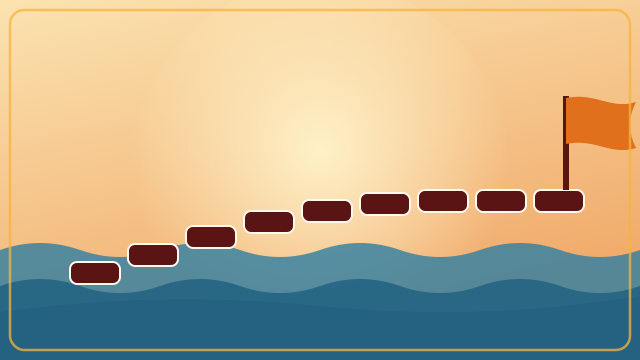
The question was the same as before: how to cross a hundred yojanas of sea? A few heroes like Hanuman could leap it, but not a whole army.
Vibhishana advised: "Ram, the Ocean is in debt to your ancestors. The sons of Sagara dug him out. Ask him for a way. He will surely show you one." It seemed to Ram the righteous thing to do.
Three days of prayer
Ram spread kusha grass on the shore, faced east, and lay down with his arm for a pillow. He vowed: "Either the Ocean will give me a way, or I will give up my life here." For three days and three nights he lay without food or water, worshipping the Ocean.
The Ocean did not come.
On the fourth day Ram's eyes reddened. "Lakshmana, see the arrogance of this sea. In this world people take calm, forgiveness and gentle speech for weakness. They honour the one who boasts, who is insolent, who punishes all alike. Meekness wins neither fame nor victory. Bring my bow. Today I will dry up this sea, and the vanaras will cross on foot."
He strung his bow and loosed his arrows. Flames rose on the water. Crocodiles and serpents were in agony. Then Ram fitted the weapon of Brahma. The sky darkened and the mountains shook. Lakshmana ran and caught his hand. "Brother, enough."
The Ocean appears
Then from among the waves the Ocean himself rose, as the sun rises from the eastern mountain: dark in colour, with a garland of pearls, and rivers such as the Ganga and the Sindhu in attendance.
He folded his hands. "Ram, earth, wind, sky, water and fire each keep to their own nature. To be fathomless is mine. I cannot give it up out of greed or out of fear. But I will tell you the way. In your army is a vanara named Nala. He is the son of Vishwakarma and has a boon from his father. Let him build a bridge over me. Whatever he places in the water, I will bear up."
Ram asked, "This arrow cannot now be drawn in vain. Where shall I send it?" The Ocean named a place in the north where robbers polluted his waters. The arrow fell there.
Five days
Nala stood up. "The Ocean has spoken the truth. I have never boasted, but I can do this."
Then began a sight that made the gods pause in the sky to watch. Vanaras and bears in their hundreds of thousands ran into the forest. One came back with a sal tree, one with a palm, one with a whole rock. Boulders the size of elephants were hauled with machines. Nala set them in the water by measure. Some vanaras held lines to keep the bridge straight; others stood with measuring rods.
Valmiki records each day's work. On the first day, fourteen yojanas. On the second, twenty. On the third, twenty-one. On the fourth, twenty-two. On the fifth, twenty-three. In five days a bridge a hundred yojanas long and ten wide was finished. From above it looked like the parting in the ocean's hair.
The squirrel
Popular tradition adds a small story here that is not in Valmiki, but which no one wants to forget. A squirrel too joined in the work. She rolled in the sand, ran on to the bridge and shook herself. The vanaras laughed: "What can you do?" Ram lifted her on his palm and stroked her back with three fingers. The three stripes on a squirrel's back, they say, are those. No work is small if it is done with a whole heart.
The tradition of southern India also holds that before building the bridge Ram set up a Shiva linga on the shore and worshipped it. That place is Rameshwaram.
The far shore
The army went on to the bridge. Vibhishana and his ministers walked in front with maces, in case the enemy came out to meet them. Ram rode on Hanuman's shoulders and Lakshmana on Angada's. Some vanaras walked on the bridge, some swam, some went leaping.
Landing on the shore of Lanka, Ram drew up the army in formation and looked at the city on the summit of Mount Trikuta. It seemed to hang in the sky.
"Lakshmana," he said, "Sita is in that city."
Last updated:
Read next
Bharata: The King Who Refused the Throne
Bharata, son of Kaikeyi, was given Ayodhya and gave it back. He ruled for fourteen years from Nandigram in the name of Shri Ram's sandals.

Shatrughna: The Quiet Brother
Shatrughna, youngest son of Dasharatha, served Bharata, kept Ayodhya running through the exile, slew Lavanasura and founded the city of Mathura.

Maharishi Valmiki: The First Poet
Maharishi Valmiki, author of the Ramayana and called Adi Kavi, the first poet: how the first shloka was born from grief, and his role in the story itself.
The Power of a Promise: Keeping Your Word
Why Shri Ram gave up a kingdom to keep his father's promise, the reasoning behind the Raghukul rule, and how to practise it in daily life.
True Friendship: Guha, Sugriva and Vibhishana
Shri Ram made friends of a tribal chief, an exiled vanara and his enemy's brother. What the Ramayana says a friend is, and what a friend must do.
Victory over Ego: The Lesson of Ravana
Ravana had learning, power and a golden city, and lost them all to pride and desire. Why the Ramayana makes its villain a scholar, and what that warns us of.