
Who Was the Father of Ram? King Dasharatha's Life, Family and Story
King Dasharatha was the father of Lord Shri Ram. Explore his family, queens, four sons, Putrakameshti Yajna, Kaikeyi’s boons and Ramayana story.
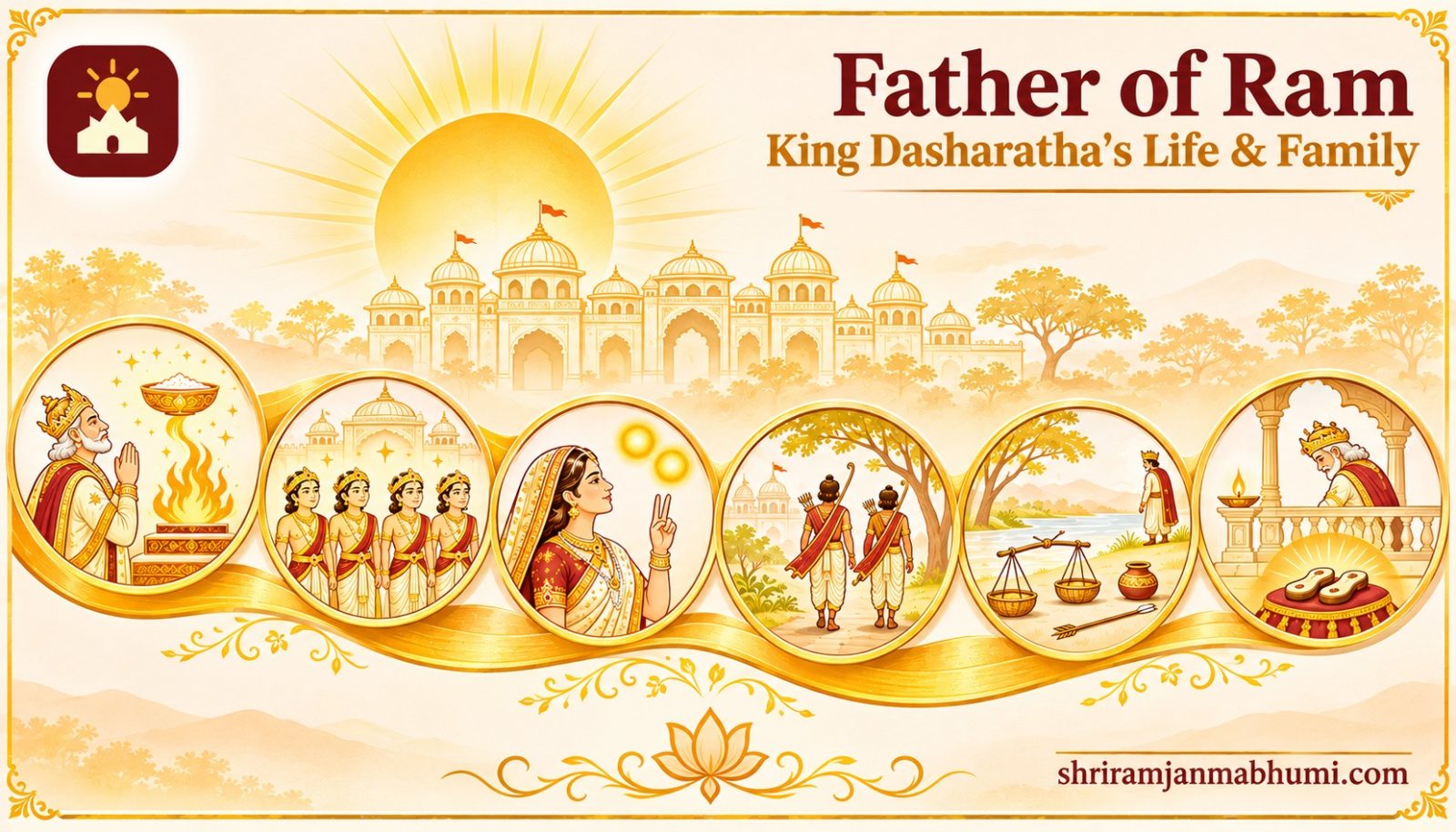
King Dasharatha, also known as Dashrath, was the father of Lord Shri Ram and the king of Ayodhya. He belonged to the ancient royal lineage associated with the Ikshvaku dynasty and the Suryavansh. His story is an important part of the Ramayana because of the birth of his four sons, his promises to Queen Kaikeyi, Shri Ram's fourteen-year exile and the grief that led to his death.
The life of King Dasharatha explains the family background of Lord Shri Ram and highlights important themes of duty, truth, family relationships and the consequences of one's actions.
Quick Facts About King Dasharatha
|
Detail |
Information |
|
Name |
King Dasharatha (Dashrath) |
|
Father |
King Aja |
|
Mother |
Queen Indumati (per Kalidasa's Raghuvamsha) |
|
Dynasty |
Ikshvaku lineage; associated with Suryavansh and Raghuvansh traditions |
|
Kingdom |
Kosala (capital Ayodhya) |
|
Principal wives |
Kaushalya, Kaikeyi and Sumitra |
|
Sons |
Shri Ram, Bharata, Lakshmana and Shatrughna |
|
Daughter |
Shanta (adopted by Romapada, in many traditions) |
|
Death |
Grief following Shri Ram's departure |
Who Was the Father of Ram?
King Dasharatha was the father of Lord Shri Ram. He ruled the kingdom of Kosala from its capital, Ayodhya. Shri Ram was born to Queen Kaushalya, Bharata to Queen Kaikeyi, and Lakshmana and Shatrughna to Queen Sumitra.
King Dasharatha's Birth, Parents and Dynasty
King Dasharatha was the son of King Aja. In Kalidasa’s Raghuvamsha, Aja is the son of King Raghu and his wife Indumati is Dasharatha’s mother. Valmiki’s genealogy (Bala Kanda, Sarga 70) differs: it names Nabhaga as Aja’s father.
Dasharatha's family is associated with the Ikshvaku dynasty and the wider Suryavansh tradition. The name Raghuvansh is connected with the celebrated King Raghu and the lineage described in Kalidasa's epic.
Explore the stories of Aja and Indumati,Ikshvaku and King Raghu to understand the different accounts of this royal lineage.
Why Was Dasharatha Called Dasharatha?
The name Dasharatha is traditionally explained as referring to a warrior whose chariot could move in all ten directions. Some interpretations explain it as one who could drive ten chariots. This traditional meaning reflects the king's reputation as a skilled and powerful chariot warrior.
Why Was King Dasharatha Famous?
King Dasharatha was remembered as a powerful ruler of Kosala and the father of Lord Shri Ram. Several important events in the Ramayana are connected with his life:
- His role in the birth of Shri Ram and his three brothers.
- The Putrakameshti Yajna performed for the birth of children.
- His three principal queens and their sons.
- His promises to Queen Kaikeyi after a battle.
- Shri Ram's fourteen-year exile.
- The incident involving the young ascetic traditionally known as Shravan Kumar.
- His final separation from Shri Ram and his death.
These events connect Dasharatha's personal life with the central story of the Ramayana.
Who Were the Three Wives of King Dasharatha?
King Dasharatha had three principal queens: Kaushalya, Kaikeyi and Sumitra. Each queen became the mother of one or more of his sons.
1. Queen Kaushalya
Queen Kaushalya was the mother of Lord Shri Ram and the chief queen of Ayodhya. She played an important role in Shri Ram's life and experienced great sorrow when he was sent into exile.
2. Queen Kaikeyi
Queen Kaikeyi was the mother of Bharata. She was known for her courage and had helped Dasharatha during a battle. Later, she asked the king to fulfil two promises, which resulted in Shri Ram's exile and Bharata being named heir to the throne.
3. Queen Sumitra
Queen Sumitra was the mother of Lakshmana and Shatrughna. Lakshmana accompanied Shri Ram during his fourteen-year exile, while Shatrughna remained closely associated with Bharata.
How Many Sons Did King Dasharatha Have?
King Dasharatha had four sons: Shri Ram, Bharata, Lakshmana and Shatrughna. Their births followed the Putrakameshti Yajna performed by the king.
|
Queen |
Son or sons |
|
Kaushalya |
Shri Ram |
|
Kaikeyi |
Bharata |
|
Sumitra |
Lakshmana and Shatrughna |
The four brothers shared a strong relationship. Shri Ram was the eldest, Bharata was devoted to his elder brother, Lakshmana accompanied Shri Ram into exile, and Shatrughna supported Bharata.
Read more about Lakshmanaand his role in Shri Ram's life. Explore the importance of brotherhood and family in the Ramayana.
Why Did King Dasharatha Perform the Putrakameshti Yajna?
King Dasharatha ruled a prosperous kingdom but was troubled because he had no children to continue his royal lineage. Following the advice of sages and royal advisers, he arranged the Putrakameshti Yajna, with Sage Rishyashringa officiating the ritual.
The account is described in Valmiki Ramayana, Bala Kanda Sargas 15–16. After the ritual, a divine figure emerged from the sacrificial fire carrying a vessel of payasam (kheer) and instructed Dasharatha to distribute it among his queens.
Dasharatha distributed the payasam among Kaushalya, Kaikeyi and Sumitra. According to the traditional account, Sumitra received two portions. Later, the queens gave birth to four sons:
- Queen Kaushalya gave birth to Shri Ram.
- Queen Kaikeyi gave birth to Bharata.
- Queen Sumitra gave birth to Lakshmana and Shatrughna.
The episode explains the birth of the four princes and the beginning of Shri Ram's earthly story.
Read the Bala Kanda of the Ramayana for the wider account of Shri Ram's birth and childhood.
Why Did Dasharatha Promise Two Boons to Kaikeyi?
One important event in Dasharatha's life was his promise to Queen Kaikeyi. In the traditional account of the battle involving the asura Shambara, Dasharatha fought alongside the gods, and Kaikeyi accompanied him as his charioteer. Her courage and quick action helped protect the king when he was in danger.
Grateful for her help, Dasharatha offered Kaikeyi two boons. She chose not to ask for them immediately and kept them for a later occasion.
Years later, when Dasharatha prepared for Shri Ram's coronation, Kaikeyi asked him to fulfil those promises. She demanded:
- Bharata should be crowned king of Ayodhya.
- Shri Ram should be sent into the forest for fourteen years.
Dasharatha was devastated by these demands. He loved Shri Ram deeply, but he believed that a king must honour his word. He felt bound by the promises he had made to Kaikeyi.
The demand and the two boons are described in Valmiki Ramayana, Ayodhya Kanda Sargas 9–12. In particular, Sarga 11 narrates Kaikeyi's demand for the two boons.
This decision changed the course of the Ramayana and led to Shri Ram's exile. Read the Ayodhya Kanda for the complete sequence.
What Is the Famous Raghukul Saying Associated with King Dasharatha?
The famous saying associated with the Raghukul tradition appears in Goswami Tulsidas's Ramcharitmanas, Ayodhya Kand:
रघुकुल रीति सदा चलि आई।
प्रान जाहुँ बरु बचनु न जाई॥
The verse expresses the belief that the Raghukul tradition values keeping one's promise, even if one's life is at stake.
A popular form of the saying is:
“Raghukul reet sada chali aayi, pran jaye par vachan na jaye.”
This is a commonly repeated simplified version of the original Awadhi lines. The quotation belongs to Tulsidas's Ramcharitmanas, Ayodhya Kand, and should not be attributed to Valmiki Ramayana.
Dasharatha's decision to honour his promise to Kaikeyi reflects this principle, even though it brought immense sorrow to his family.
Shravan Kumar’s Curse: Why Was Dasharatha Cursed?
Dasharatha was cursed by the father of a young ascetic whom he accidentally killed with an arrow while hunting near the Sarayu River.
The story of Shravan Kumar is one of the most emotional episodes associated with King Dasharatha. Shravan Kumar is the traditional name widely used for the young man in this story. In Valmiki Ramayana, the young man is described as an ascetic youth rather than explicitly named Shravan Kumar.
On the sixth night after Shri Ram's departure for the forest, Dasharatha was overwhelmed by grief. At midnight, while speaking to Queen Kaushalya, he remembered an incident from his youth and narrated how he had accidentally killed a young ascetic near the Sarayu River.
When Dasharatha was young, he went hunting at night. He was skilled in shooting by sound. Hearing a noise near the river, he mistook it for an animal drinking water and released an arrow. However, the arrow struck a young ascetic who had gone to collect water for his blind, elderly parents.
The injured young man asked Dasharatha to take water to his parents and tell them what had happened. Dasharatha approached the couple, explained his mistake and took them to their son's body. The parents were devastated by the news.
The boy's father pronounced the curse: as he was dying of grief for his son, Dasharatha too would die grieving for his own son. The aged couple then gave up their lives on their son's funeral pyre.
This incident became deeply significant later in Dasharatha's life, when he experienced the pain of separation from Shri Ram.
Text references: Valmiki Ramayana, Ayodhya Kanda Sarga 63 describes the young ascetic's death and Dasharatha recalling the incident to Kaushalya. Sarga 64 describes the parents' grief, the father's curse and the couple's death on the funeral pyre.
How Did King Dasharatha Die?
King Dasharatha died in Ayodhya of grief after Shri Ram’s exile.
On the sixth night after Ram left, at midnight, he told Queen Kaushalya the story of the young ascetic and the curse (Valmiki Ramayana, Ayodhya Kanda, Sargas 63–64). After narrating it, he died of grief.
Ram and Lakshmana were in the forest, and Bharata and Shatrughna were in the Kekaya kingdom, so none of his four sons was beside him. In his final hours he repeatedly called Shri Ram’s name.
What Happened to Bharata After King Dasharatha's Death?
When Bharata returned to Ayodhya from the Kekaya kingdom, he learned that King Dasharatha had died and Shri Ram had been sent into exile. He was deeply saddened and refused to accept the throne obtained through Kaikeyi's demands.
Bharata travelled to meet Shri Ram and requested him to return to Ayodhya. However, Shri Ram declined because he had decided to honour his father's promise and complete the fourteen-year exile.
Bharata then took Shri Ram's sandals, known as the paduka, back to Ayodhya. He placed them on the throne and governed the kingdom in Shri Ram's name.
Instead of living in the royal palace, Bharata stayed at Bharat Kund, Nandigram, living a simple life while waiting for Shri Ram's return.
This episode reflects Bharata's loyalty, humility and devotion to his elder brother.
What Do We Learn from the Life of King Dasharatha?
The story of King Dasharatha offers important lessons about family, responsibility, promises and the consequences of our actions.
1. Think Carefully Before Making Promises
Dasharatha's two boons to Kaikeyi later became the reason for Shri Ram's exile. His story reminds us to think carefully before making promises and commitments.
2. Understand the Consequences of Our Actions
The incident involving the young ascetic shows how an action taken by mistake can have serious consequences. Dasharatha carried the memory of that incident throughout his life.
3. Value Family Relationships
Dasharatha's grief after Shri Ram's departure shows the emotional bond between a parent and a child. His story reminds us to value our family relationships.
4. Respect Parents and Elders
Shri Ram's conduct towards Dasharatha and Queen Kaushalya is an important example of respect for parents. Even when he had to leave Ayodhya, he chose to honour his father's word.
Read more in our guide on Respect for Parents and Teachers.
5. Keep Your Word and Act Responsibly
The Raghukul saying highlights the importance of truth and keeping one's promises. Dasharatha's story also reminds us that commitments should be made thoughtfully because they can affect many lives.
Where Is Dashrath Mahal Located?
Dashrath Mahal is located in the Ramkot area of Ayodhya, Uttar Pradesh. It is traditionally revered as the palace associated with King Dasharatha, where Shri Ram and his brothers are believed to have spent their childhood.
The site is an important place of devotion for visitors exploring the Ramayana-related places of Ayodhya. It is also popularly known as Bada Asthan or Badi Jagah.
Visitors interested in the history and religious significance of Ayodhya can explore our Dashrath Mahal guide before planning their visit.
Conclusion
King Dasharatha holds an important place in the Ramayana as the father of Lord Shri Ram and the ruler of Kosala. His life includes stories of courage, family relationships, promises, mistakes and deep sorrow.
From the Putrakameshti Yajna and the birth of his four sons to Kaikeyi's two boons, the Shravan Kumar episode and his final separation from Shri Ram, Dasharatha's story helps readers understand the events that shaped the Ramayana.
His life reminds us to value family relationships, act responsibly and think carefully before making promises. To explore more about Shri Ram's royal lineage and family, continue reading about Shri Ram,Maharishi Valmiki and Luv and Kush.
Frequently asked questions
Why Was Dasharatha Called Dasharatha?
Did King Dasharatha Have a Daughter?
Who Cursed King Dasharatha?
How Did Dasharatha Die?
Where Is Dashrath Mahal Located?
Who Was King Aja?
Which Yajna Did King Dasharatha Perform to Have Children?
Last updated:
Read next

Lakshmana: The Devoted Brother
Lakshmana, son of Sumitra, followed Shri Ram into exile, guarded him for fourteen years and slew Indrajit. His life, his temper and his loyalty.

Vibhishana: Choosing Right over Family
Vibhishana, brother of Ravana, advised him to return Sita, was driven out, took refuge with Shri Ram and became the righteous king of Lanka.

Maharishi Valmiki: The First Poet
Maharishi Valmiki, author of the Ramayana and called Adi Kavi, the first poet: how the first shloka was born from grief, and his role in the story itself.
Equality and Compassion: Shabari, Kevat and Jatayu
Shri Ram ate a tribal woman's berries, embraced a boatman and gave a bird a father's funeral. What these episodes teach about dignity and birth.
Victory over Ego: The Lesson of Ravana
Ravana had learning, power and a golden city, and lost them all to pride and desire. Why the Ramayana makes its villain a scholar, and what that warns us of.

Ram Rajya: Leadership as Service
What Ram Rajya meant in the Ramayana, the principles behind it, and how they apply to anyone who leads a family, a team, a business or a government.